
- All
- Product Name
- Product Keyword
- Product Model
- Product Summary
- Product Description
- Multi Field Search


Views: 0 Author: Site Editor Publish Time: 2026-02-23 Origin: Site


Selecting the correct High-Density Polyethylene (HDPE) fittings requires more than simply matching nominal pipe sizes. Unlike traditional materials such as ductile iron or carbon steel, where standardized dimensions remain static, HDPE specifications are dynamic. They depend heavily on variable pressure ratings, resin classifications like PE4710, and the specific manufacturing method employed—whether molded or fabricated. These variables create a complex matrix that engineers must navigate to ensure system integrity.
For engineers and procurement managers, the challenge often lies in distinguishing between incompatible sizing systems like Iron Pipe Size (IPS) and Ductile Iron Pipe Size (DIPS). You must also account for flow reduction caused by the significant wall thickness of high-pressure polyethylene. Furthermore, installation methods dramatically impact the final specification, as thermal expansion and contraction require specific anchoring strategies. This guide provides a technical framework for evaluating HDPE fittings dimensions, ensuring hydraulic compatibility and long-term structural integrity in pressure, industrial, and municipal applications.
Sizing Systems are Not Interchangeable: distinct incompatibility exists between Iron Pipe Size (IPS) and Ductile Iron Pipe Size (DIPS); specification must match the mating infrastructure.
Pressure Derating applies to Fabrication: While molded fittings often carry full pressure ratings, fabricated (mitered) fittings typically require a 20-25% pressure reduction (derating) compared to the pipe.
Internal Diameter (ID) Fluctuates: Higher pressure ratings (lower SDR) result in thicker walls and reduced ID. HDPE often requires upsizing by one nominal diameter to match the flow capacity of Ductile Iron or PVC.
Temperature Impacts Ratings: Service temperatures above 73°F (23°C) require applying specific reduction coefficients to the pressure class.
Anchoring is Critical: Due to the Poisson Effect, HDPE expands/contracts significantly; specifications must include concrete anchoring or restraint mechanisms at connection points to prevent pull-out.
Before you evaluate pressure ratings or wall thickness, the project specification must strictly lock in the sizing standard. Mixing these systems remains the leading cause of field installation failures and costly delays. A 6-inch pipe in one standard does not physically mate with a 6-inch pipe in another without specialized adapters.
IPS is the dominant standard for industrial markets. You will find it specified almost exclusively in oil and gas gathering lines, mining slurry transport, and landfill methane systems. The dimensional logic here matches the Outer Diameter (OD) of carbon steel piping. This compatibility allows for easier integration with existing steel infrastructure using standard compression fittings or flange adapters.
If your project involves industrial process water or chemical transport, you are likely working within the IPS ecosystem. It is crucial to verify this early, as attempting to bolt an IPS flange to a DIPS pump flange often results in misalignment or bolt-hole incompatibility.
DIPS is the standard for North American municipal water and sewer specifications, governed largely by AWWA standards. The dimensional logic matches the OD of ductile iron pipe. This design choice facilitates retrofits in existing municipal water mains, allowing utility crews to repair or extend iron systems with polyethylene without needing complex transition calculations.
The critical constraint here is physical incompatibility. An 8" IPS fitting will not fuse to an 8" DIPS pipe. The variance in outer diameter means the heating irons on a fusion machine will not make contact, and mechanical restraints will not grip the pipe surface correctly.
While IPS and DIPS dominate main lines, you may encounter other standards in smaller diameters or older specifications. Copper Tubing Size (CTS) is restricted to small-diameter tubing, typically under 2 inches, used primarily for service lines connecting mains to meters.
SIDR (Standard Inside Diameter Ratio) focuses on a controlled internal diameter. However, as of 2020, SIDR has been largely removed from AWWA C901 standards. Modern specifications should migrate entirely to OD-controlled pipe. If you encounter a legacy spec calling for SIDR, we recommend updating it to ensure current compliance and broader availability of compatible HDPE fittings.
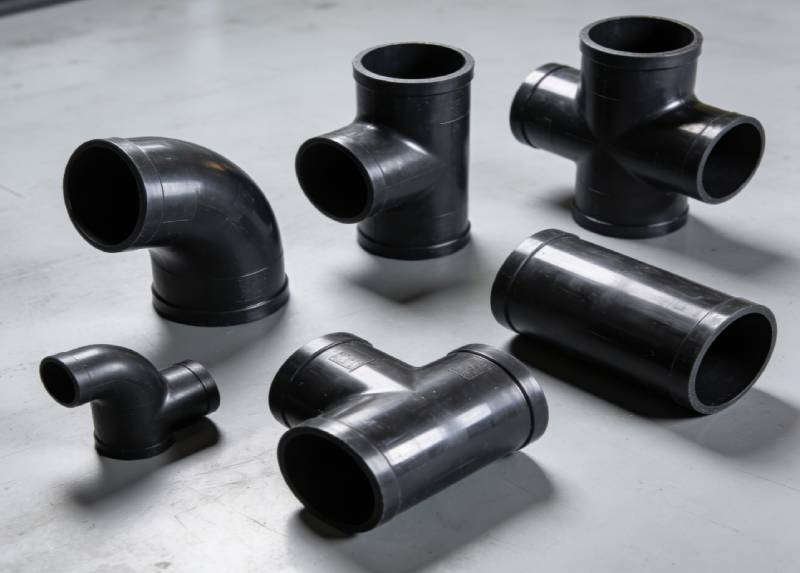
Once the sizing standard is defined, the next step is determining the wall thickness required to handle the system's pressure. In the polyethylene world, this is defined by the Standard Dimension Ratio (SDR). Understanding SDR is critical because it dictates both the pressure capacity and the hydraulic efficiency of the fitting.
The formula for SDR is straightforward: SDR = Outer Diameter / Minimum Wall Thickness.
This creates an inverse relationship. A lower SDR number indicates a thicker wall and, consequently, a higher pressure rating. Conversely, a high SDR number means a thinner wall and lower pressure capacity.
| SDR Class | Approximate Pressure Rating (PE4710) | Typical Application |
|---|---|---|
| SDR 7 | 335+ psi | Ultra-high pressure, deep mining, directional drilling |
| SDR 9 | 250 psi | High-pressure water injection, fire loops |
| SDR 11 | 200 psi | Standard industrial, municipal water mains |
| SDR 17 | 125 psi | Gravity sewer, low-pressure drainage, irrigation |
| SDR 26 | 80 psi | Open channel flow, low-head gravity lines |
The pressure rating of an SDR class depends heavily on the resin used. Modern specifications should explicitly require PE4710 resin (ASTM D3350 Cell Class 445574C). PE4710 represents a significant leap forward from the legacy PE3408 resin.
PE4710 offers superior resistance to Slow Crack Growth (SCG). This durability allows engineering bodies (like PPI TR-4) to permit a higher design factor (0.63). Practically, this means a PE4710 fitting can handle higher pressures than an older PE3408 fitting of the exact same wall thickness. When sourcing components, always confirm the HDPE fittings manufacturer is using certified PE4710 resin to maximize performance.
One of the distinct advantages of HDPE is its ductility, which provides excellent surge resistance. For recurring surges (frequent pump starts/stops), fittings can typically withstand 1.5 times their rated pressure. For occasional, emergency surges (like a sudden valve closure or power failure), they can withstand 2.0 times the rated pressure. This capability often reduces the need for massive thrust blocks or surge tanks compared to rigid pipe materials like PVC or steel.
A "standard" HDPE fitting does not truly exist in a vacuum. The method used to manufacture the fitting dictates whether it holds the same pressure rating as the mating pipe or requires significant derating. This is a common oversight in procurement that can lead to weak points in a pressure piping system.
Molded fittings are created by injecting molten polymer into a pre-shaped mold. They are seamless, single-piece components. Typically, molded fittings are Full Pressure Rated. If you buy an SDR 11 molded tee, it generally matches the 200 psi pressure capacity of the SDR 11 pipe it connects to.
However, availability is a constraint. Mold costs are astronomical for large diameters. Consequently, you will generally find molded fittings limited to sizes 12 inches and smaller, though some manufacturers offer larger molded caps or reducers.
For sizes larger than 12 inches, or for custom angles, manufacturers use fabrication. This involves cutting sections of HDPE pipe and fusing them together to form elbows, tees, or wyes. While versatile, this method introduces a critical specification check: Pressure Derating.
Fabricated fittings typically do not hold the full pressure rating of the pipe stock they are made from. Due to stress concentrations at the mitered fusion joints, these fittings are often rated at only 75% or 80% of the pipe's class. For example, if your system operates at 160 psi, specifying SDR 11 pipe (rated 200 psi) seems safe. However, a fabricated SDR 11 fitting might only be rated for 150 psi (75% of 200), creating a system that is technically under-designed. You must verify the specific Hydrostatic Design Basis (HDB) with the HDPE fittings manufacturer.
Machined fittings are carved from solid billet stock. This method is common for heavy flange adapters or specialized components. These are usually fully rated, but because they are machined from a solid block, the material properties can vary slightly from extruded pipe. Verifying the manufacturer’s data sheet is mandatory to ensure compliance with the system's maximum operating pressure.
HDPE achieves its pressure resistance by thickening the pipe wall. Unlike steel or PVC, where the internal diameter (ID) remains relatively constant across pressure classes, the ID of HDPE shrinks significantly as the pressure rating rises (SDR decreases). This physical reality necessitates a careful review of hydraulic capacity.
Engineers must calculate the actual flow area rather than relying on the nominal size name. The calculation generally follows this logic:
Average ID ≈ OD - (2 × Minimum Wall Thickness × 1.06)
The "1.06" factor accounts for wall thickness tolerances, as manufacturers often produce walls slightly thicker than the minimum to ensure compliance. In high-pressure applications (like SDR 7 or SDR 9), the wall becomes so thick that the internal flow path is restricted, potentially increasing friction loss and pumping costs.
To mitigate this, a common engineering rule of thumb is the "One Size Up" strategy. To maintain the same hydraulic capacity (GPM) as an existing Ductile Iron or PVC line, the HDPE replacement often requires one nominal size larger.
For instance, if you are replacing a 6-inch Ductile Iron line, specifying a 6-inch HDPE line (SDR 11) will result in a smaller ID and higher head loss. Instead, engineers will often specify an 8-inch HDPE line. Despite HDPE having a very favorable C-Factor (typically 150, indicating high smoothness), the reduction in cross-sectional area usually outweighs the smoothness benefit unless you upsize the pipe.
If your application requires pigging (cleaning with a mechanical device) or liner insertion, you should not rely on the "Average ID." Instead, specify the "Drift Diameter." The fusion process creates an internal bead of molten plastic that protrudes into the flow path. The Drift Diameter accounts for this obstruction, ensuring that cleaning pigs or inspection cameras can pass through the fittings without getting stuck.
Physical dimensions form the baseline, but environmental variables fundamentally alter the effective performance of HDPE fittings. Ignoring thermal and mechanical forces is a primary cause of joint separation and flange leaks.
Standard pressure ratings for HDPE fittings are established at 73°F (23°C). Polyethylene is a thermoplastic, meaning its strength decreases as temperature increases.
If your system operates at 100°F, the pressure capacity may drop by approximately 20%. In industrial effluent applications reaching 140°F, the capacity can drop by as much as 50%. Specifications for exposed surface lines (subject to direct solar heating) or hot industrial processes must calculate the *derated* pressure class. You cannot simply use the nominal rating listed in the catalog.
HDPE behaves differently under pressure than rigid materials. When pressurized, the pipe expands slightly in diameter. Due to the Poisson Effect, this radial expansion causes the pipe to contract in length. In a long, unrestricted run of pipe, this contraction can generate thousands of pounds of "pull-out" force at the connection points.
Standard mechanical joints (MJ) used for iron pipes are insufficient to hold this force; the HDPE will simply shrink and pull out of the socket. Specifications must mandate Concrete In-Line Anchors (thrust blocks designed for tension, not just compression) or fully restrained MJ adapters equipped with gripping teeth. These restraints dig into the pipe wall to prevent separation. Failing to anchor transitions between HDPE and rigid piping (like valves or pumps) is an invitation for catastrophic joint separation.
Specifying HDPE fittings is not a direct "apples-to-apples" substitution for metallic or PVC components. The decision matrix must account for the specific sizing standard (DIPS vs. IPS), the manufacturing method's impact on pressure ratings (molded vs. fabricated), and the hydraulic realities of wall thickness. A successful project relies on recognizing that a 6-inch SDR 11 fitting is not a universal component—it is a specific engineered product with defined thermal and hydraulic limits.
For a compliant, long-lasting system, specifications should strictly prohibit air testing for safety, mandate data logging for all fusion joints (ASTM F3190), and verify that all suppliers provide ISO 9001 certified traceability for their resin lots.
Next Steps for Evaluation:
Confirm the existing piping interface (Iron or Standard OD) to prevent field incompatibility.
Calculate the derated pressure requirement based on the maximum service temperature of the fluid.
Request submittals comparing Molded vs. Fabricated pressure ratings for the specific bill of materials to uncover hidden derating factors.
A: Functionally, they are the same ratio (OD divided by wall thickness). SDR (Standard Dimension Ratio) refers to a specific series of standard ratios (like 11, 17, 21) derived from ANSI standards, while DR is a general term. A lower number always indicates a thicker wall and higher pressure rating. SDR allows for standardized production, ensuring compatibility across different manufacturers.
A: No, not directly. The outer diameters are different. You must use a specialized transition adapter or a mechanical coupling designed specifically to grip both ODs. Attempting to butt fuse IPS to DIPS is impossible and a major field error, as the heating plates will not contact the pipe ends evenly.
A: Rarely. Fabricated (mitered) fittings usually require a pressure reduction factor (typically 0.75 or 0.80) depending on the complexity of the angle and the manufacturer's design. Always verify the specific pressure class of the fitting, not just the pipe it is made from, to ensure the system meets safety requirements.
A: Compressed air stores immense potential energy. If an HDPE fitting or joint fails during an air test, it can explode with shrapnel-like force, causing fatal injuries. Hydrostatic (water) testing is the only industry-approved method (ASTM F2164) for pressure testing HDPE systems because water is incompressible and dissipates energy quickly upon failure.
A: Because HDPE requires thick walls to handle pressure, its internal diameter is smaller than steel or PVC of the same "nominal" size. To maintain the same flow rate without increasing pumping costs, engineers often specify HDPE pipe and fittings one nominal size larger than the steel pipe being replaced.


