
- All
- Product Name
- Product Keyword
- Product Model
- Product Summary
- Product Description
- Multi Field Search


Views: 0 Author: Site Editor Publish Time: 2026-02-28 Origin: Site


Selecting the right material for piping infrastructure is rarely a simple commodity purchase; it is a critical risk management decision that dictates the longevity, leakage rates, and maintenance liability of a network for decades. While engineers and project managers often focus heavily on the pipe specification itself, the fittings—elbows, tees, adapters, and joints—are statistically the most common failure points in any piping system. A pipe is only as reliable as its connections, and the difference in how materials handle stress at these joints is profound.
The debate between High-Density Polyethylene (HDPE) and Polyvinyl Chloride (PVC) often creates confusion due to overlapping pressure ratings and applications. However, these materials behave fundamentally differently under stress. While pipe material quality is essential, the structural integrity of the fittings frequently determines the system's total lifespan. This guide moves beyond basic definitions to compare stress handling, installation realities, and Total Cost of Ownership (TCO), helping you determine which material aligns best with your specific project requirements.
Connection Integrity: HDPE fittings utilize heat fusion to create monolithic (seamless) joints, whereas PVC relies on gaskets or solvent welds which introduce potential leak paths.
Stress Management: HDPE is viscoelastic (absorbs surge/shock), while PVC is amorphous/rigid (resists pressure but is susceptible to brittle failure).
Temperature & Environment: HDPE handles freeze-thaw cycles (-180°F tolerance) and unstable soils; PVC is superior in specific chemical environments like high-concentration chlorine.
Cost Dynamics: PVC typically offers lower upfront material costs, while HDPE provides lower lifecycle costs through reduced maintenance and trenchless installation capabilities.
To understand why fittings fail, we must look at the molecular structure of the materials. The primary distinction lies in how the polymer chains react when subjected to external forces, such as ground movement or internal pressure spikes.
PVC is an amorphous polymer. Structurally, this means its polymer chains are randomly arranged, resulting in a material that offers high tensile strength and stiffness. While this rigidity allows PVC to hold its shape well under static pressure, it makes the material "notch sensitive." When a PVC fitting sustains a scratch or gouge, the stress concentrates at that specific point, creating a high risk of crack propagation and brittle fracture.
In contrast, HDPE is a semi-crystalline, viscoelastic polymer. It combines the characteristics of a solid and a fluid. This unique property allows HDPE fittings to deform under stress without structural failure. Instead of cracking when overloaded, the material yields and distributes the stress across a wider area. This ductility is the primary reason HDPE is preferred in dynamic environments where ground shifting or vibration is inevitable.
Pressure surges, often caused by the rapid opening or closing of valves (water hammer), are a leading cause of pipeline fatigue. The behavior of fittings during these events is a critical safety factor.
Surge Tolerance: HDPE possesses a high resistance to fatigue. It can withstand recurring surge events up to 2 times its pressure class without damage. PVC has a much smaller buffer, typically limited to roughly 100 psi over its pressure rating. Repeated surges in a rigid PVC system can lead to cumulative fatigue damage and eventual bursting.
Flow Velocity Limits: The ability to handle high-velocity flow further illustrates the difference. Safe flow velocity thresholds for PVC are generally capped at around 5.5 feet per second (fps). HDPE systems can safely operate at velocities up to 14 fps. This allows engineers to design high-demand pressure systems without fearing that the turbulence will compromise the fitting integrity.
Handling damage during installation is a reality of construction sites. If a PVC fitting is scratched during transport or installation, that scratch becomes a stress riser—a focal point for potential failure. Manufacturers often recommend discarding PVC components with significant surface scratches. Conversely, HDPE is remarkably forgiving. Deep scratches, even those reaching up to 10% of the wall thickness, do not derate the pressure rating of the fitting. The viscoelastic nature of the polymer effectively "blunts" the crack tip, preventing it from growing deeper under pressure.
The methodology used to connect pipe segments is arguably the most significant differentiator between these two systems. It determines not only the leak rate but also the mechanical stability of the entire network.
Municipal water systems worldwide lose a staggering amount of treated water to "background leakage"—small, undetectable leaks at pipe joints. HDPE fittings solve this by creating a "Monolithic System." Through butt fusion or electrofusion, the fitting and the pipe are heated and pressed together until they form a single, continuous chain of polymer. The resulting joint is as strong as, or often stronger than, the pipe itself. This fusion process effectively eliminates joint leakage points.
PVC fittings typically rely on bell-and-spigot connections sealed with rubber gaskets or solvent welding (gluing). While effective in many applications, gaskets are mechanical seals that can degrade over time. They are susceptible to displacement during installation (rolling gaskets), root intrusion in sewage applications, and separation if the ground settles. Solvent welds, while chemical in nature, can suffer from improper application, such as insufficient curing time or contamination during the bonding process.
The concept of restraint is vital for pressurized lines. Internal pressure tries to push fittings apart, especially at bends and tees.
HDPE: Because they are fused, HDPE systems are fully self-restrained. You do not need to install concrete thrust blocks at directional changes because the fused joint can withstand the longitudinal pull-out forces. This simplifies trench design and reduces labor.
PVC: Bell-and-spigot PVC joints are unrestrained. Without external support, internal pressure will force the pipe out of the fitting. Installation requires the pouring of concrete thrust blocks at every turn, tee, or dead end to transfer the load to the surrounding soil. This adds significant complexity, labor hours, and curing time to the installation schedule.
Achieving a perfect fusion weld requires material compatibility. Variations in resin density or melt flow index can compromise the integrity of a joint. Therefore, it is critical to source components from a reputable HDPE fittings manufacturer. Consistent manufacturing standards ensure that the fittings possess the correct dimensional tolerances and resin compatibility to bond perfectly with the pipe, guaranteeing the monolithic performance the system is designed for.
Piping systems are rarely installed in sterile, temperature-controlled labs. They face freezing winters, shifting tectonic plates, and aggressive chemical flow. Here is how the materials compare in harsh environments.
Temperature fluctuations reveal the stark contrast between ductility and brittleness.
Freeze/Thaw: Water expands when it freezes. In a rigid PVC pipe, this expansion creates immense hoop stress that often shatters the pipe or fitting. PVC becomes increasingly brittle as temperatures drop below 32°F. HDPE remains ductile down to -180°F. If water freezes inside an HDPE line, the material simply expands to accommodate the ice and retracts to its original shape when it thaws, preventing catastrophic bursts.
Heat Handling: Standard PVC has a lower thermal threshold, typically losing strength rapidly above 140°F. While CPVC is available for hot water, standard PVC is not suitable for high-temperature discharge. HDPE generally handles a broader temperature range, though pressure de-rating is necessary as temperatures rise.
While HDPE is generally considered more chemically inert, there are specific scenarios where PVC outperforms it. The choice depends heavily on the fluid being transported.
| Feature | HDPE Performance | PVC Performance |
|---|---|---|
| Acids & Bases (pH 1.5–14) | Excellent. Unaffected by most aggressive soils and industrial wastewater. | Good, but can be susceptible to specific solvents. |
| Hydrocarbons (Oil/Gas) | Superior. The standard for natural gas distribution and oil gathering lines. | Poor. Hydrocarbons can soften and degrade PVC. |
| Strong Oxidizers (Chlorine) | Fair. Long-term exposure to high concentrations can cause oxidation. | Superior. Ideal for swimming pools and high-concentration bleach lines (>50ppm). |
| Solvents | Resistant to many organic solvents. | Susceptible to swelling or dissolution (hence solvent welding works). |
Above-ground installations expose materials to ultraviolet radiation, which attacks polymer chains. PVC suffers from "Sunburn," or dehydrochlorination, where UV exposure causes the material to discolor (yellow/brown) and eventually micro-crack. This can reduce impact strength by up to 30%. HDPE fittings are typically manufactured with 2-3% Carbon Black. This additive effectively blocks UV radiation, allowing HDPE to remain in direct sunlight for decades without significant degradation of physical properties.
The cost and feasibility of a project often depend on how the pipe gets into the ground. The physical flexibility of the material dictates the installation method.
Flexibility is a massive asset in complex terrain. HDPE fittings and pipes have a high degree of flexibility, allowing for a bend radius of 20 to 25 times the pipe diameter. This means the pipe can be curved around obstacles, reducing the need for manufactured elbows and minimizing flow restriction. PVC is rigid. Every directional change requires a fitting, and every fitting introduces a potential leak path and a friction loss point. In rough terrain, the sheer number of PVC fittings required can skyrocket compared to a continuous HDPE loop.
As cities become denser, tearing up roads for "open cut" installation becomes prohibitively expensive and disruptive. HDPE is the dominant material for trenchless technologies like Horizontal Directional Drilling (HDD), pipe bursting, and slip-lining. Its high tensile strength allows it to be pulled through the earth over long distances without snapping. The smooth exterior and fused joints ensure it doesn't snag.
PVC is generally restricted to traditional open-trench installation ("dig and replace"). While fusible PVC exists, standard bell-and-spigot PVC cannot be pulled through a borehole because the joints would separate under the tensile load. Open trenching involves significant restoration costs, including repaving roads, repairing landscapes, and managing traffic closures.
In areas with unstable soil—such as earthquake zones, liquefaction areas, or settling landfills—rigid pipes are a liability. Ground movement exerts shear forces that snap rigid joints. We highly recommend specifying HDPE fittings in these environments. The flexibility of the system allows it to move with the earth, maintaining containment even during significant seismic events or ground settling.
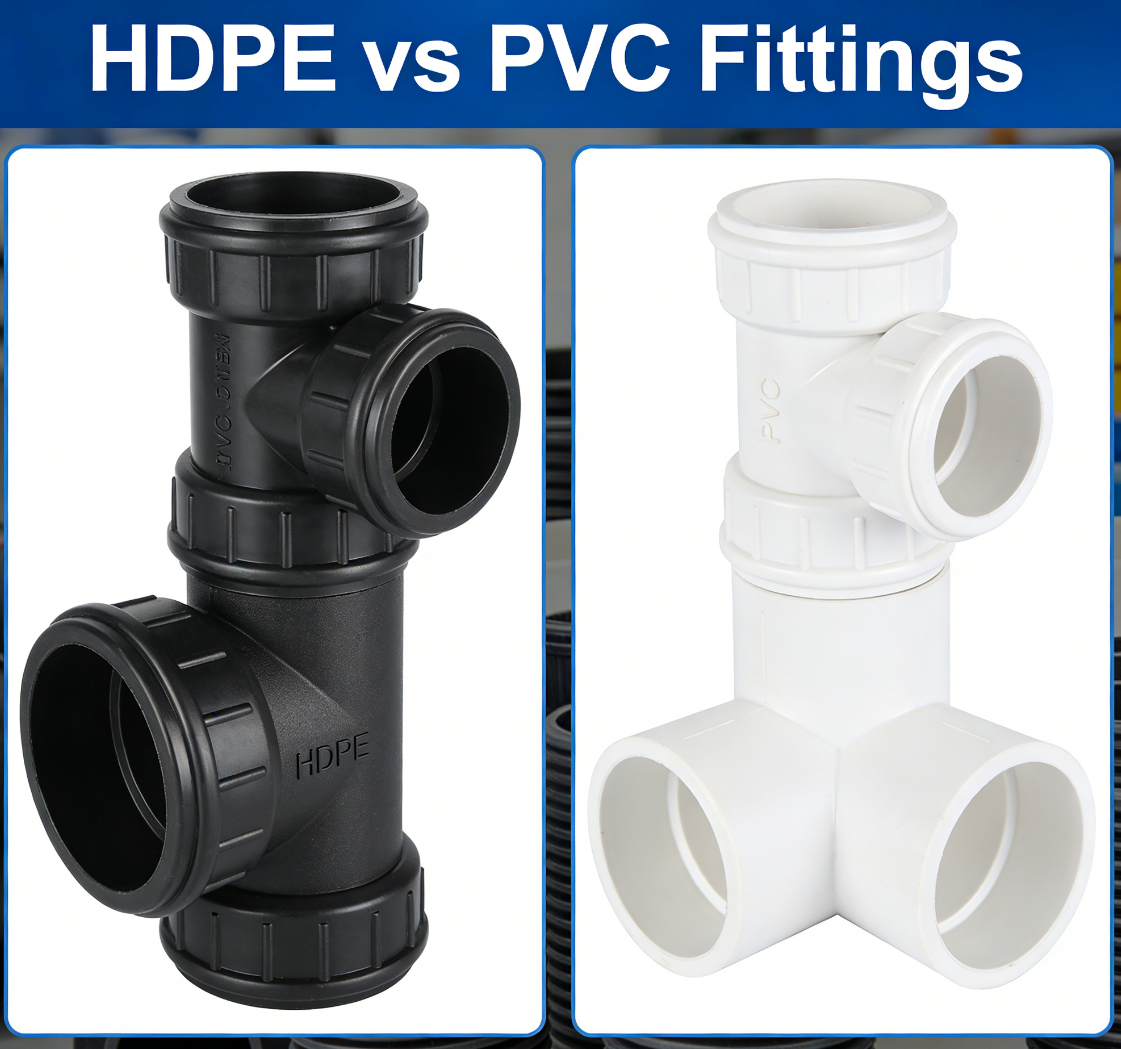
Budgeting for piping infrastructure requires looking beyond the initial invoice. There is a distinct difference between the capital expenditure (CAPEX) required to buy the materials and the total cost of ownership (TCO) over the asset's life.
If the decision is based solely on the purchase order price, PVC usually wins. Historically, PVC material costs are 10-30% lower than HDPE for comparable diameters. Additionally, installing PVC requires less specialized equipment; crews do not need hydraulic fusion machines or certified fusion technicians, which can lower the daily "burn rate" of the installation crew for straightforward, open-trench projects.
When you zoom out to the full lifecycle, the economics often shift in favor of HDPE. Several factors drive this value reversal:
Installation Savings: By eliminating concrete thrust blocks and narrowing trench widths (no need for workers to stand in the trench to assemble joints), HDPE reduces civil engineering costs. Trenchless methods can reduce total project costs by 50% or more by avoiding surface restoration.
Maintenance & Lifespan: PVC systems generally have a projected service life of 50 to 70 years. HDPE systems are conservatively rated for 100+ years. That effectively doubles the asset value.
Reliability Data: The "cost of reliability" is real. Industry statistics suggest a failure rate for HDPE of approximately 1 failure per 10 million feet of pipe. In contrast, PVC failure rates hover around 1 failure per 48,000 feet. The cost of repairing a single main break under a paved city street often exceeds the initial material savings of choosing PVC.
The choice between HDPE and PVC fittings is not about declaring one material "better" in a vacuum; it is about matching material properties to the specific risks and demands of your project. Each polymer has a distinct "winning" scenario.
Choose PVC when: You are installing gravity sewer mains, indoor plumbing, or swimming pool systems where chlorine resistance is paramount. It is also a logical choice for projects with strict upfront budget caps, stable soil conditions, and where open-trench installation is feasible.
Choose HDPE when: You require a zero-leakage system for critical pressure water or gas lines. It is the definitive choice for trenchless installation (HDD), areas with unstable ground or high seismic activity, and industrial applications involving aggressive hydrocarbons or acids.
Final Decision Tip: While PVC often saves money at the purchase order stage, HDPE typically saves money at the project completion and asset management stage. For infrastructure intended to serve future generations with minimal maintenance, the monolithic integrity of fused HDPE provides a superior return on investment.
A: No, you cannot glue them. HDPE and PVC are chemically incompatible, and solvent cements used for PVC will not bond with HDPE. To join them, you must use mechanical transitions, such as flange adapters, male/female threaded adapters, or specialized mechanical compression couplings designed to grip both materials securely.
A: It depends on how you define "strength." PVC has higher tensile strength and is stiffer, allowing it to handle high static pressure with thinner walls. However, HDPE has significantly higher impact strength and fatigue resistance. HDPE is tougher and more durable under dynamic stress (surge/shock), whereas PVC is stronger against static bursting but more brittle.
A: HDPE fittings are typically black because they contain 2-3% Carbon Black. This additive is mixed into the resin during manufacturing to provide powerful protection against ultraviolet (UV) radiation. This allows the fittings to be stored or installed above ground in direct sunlight without degrading or becoming brittle over time.
A: Yes, HDPE is highly recyclable (Code #2). It can be melted down and reformed multiple times without losing significant structural properties. PVC (Code #3) is more difficult to recycle due to its chlorine content and the presence of various additives, making HDPE the more environmentally friendly option for a circular economy.


